
Live cricket betting is where the bulk of cricket wagering activity in India actually happens. Pre-match odds capture the best analysis available before the first ball, but the match itself produces a constant flow of new information that live markets reflect in real time. A bettor who can read what’s happening on the pitch and judge how it shifts the probability of different outcomes holds a meaningful edge over one who relies only on pre-match positions. For Indian players who want the most out of their cricket betting, getting comfortable with live markets is one of the most valuable skills to develop alongside the broader knowledge in the Cricket Betting guide.
How Live Cricket Betting Mechanics Work
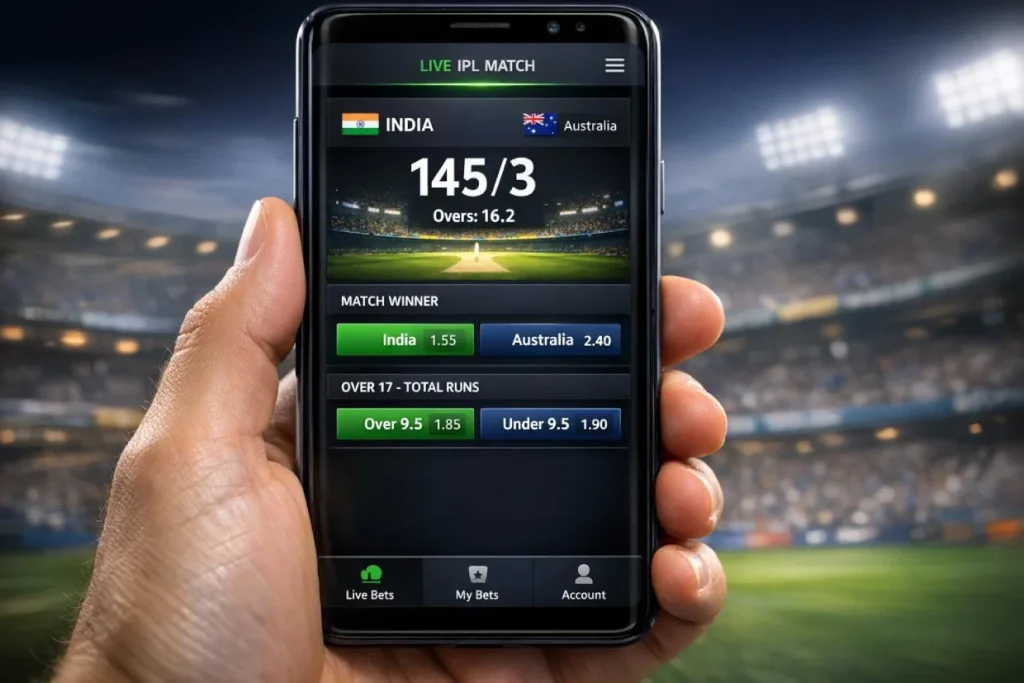
Live cricket betting allows players to place wagers as a match is unfolding, with odds shifting after each delivery, wicket, and scoring shot. Unlike traditional pre-match betting, where odds get fixed before play begins, in-play markets move in real time and reflect the current match state along with the chances of every outcome still on the table.
When key events happen, markets briefly suspend so odds can be recalculated, then reopen at fresh prices. Wicket dismissals, boundaries, and over completions are the most common triggers. The real edge in live betting comes from watching the match closely and reading the situation faster than the market reprices — spotting value before the odds settle at their true level.
Live betting runs across every match format on www.SkyExchLogin.co. T20 fixtures and IPL games produce the fastest-moving in-play markets thanks to compressed timelines where every over carries weight. Test cricket plays out slower, but often opens up richer opportunities because the longer format gives situations time to develop across multiple sessions and days.
The trigger events that shape any match in-play include:
- Wicket dismissals — the highest-impact event, immediately reshaping match outcome odds and recalibrating session and total runs markets
- End of the powerplay — fielding restrictions lift, the scoring environment resets, and innings total markets get recalculated
- Toss outcome — at venues with a strong historical bias toward batting first or chasing, the toss alone can shift odds before a single ball is bowled
- First innings completion — once the opening innings total locks in, every market resets according to the chase target, second-innings conditions, and the chasing side’s strength
- Weather interruptions — these activate the DLS calculation and can fundamentally change the match scenario for any active position
Online Live Cricket Betting on www.SkyExchLogin.co
www.SkyExchLogin.co delivers real-time in-play access for Indian players across every major cricket tournament, year-round. The platform refreshes odds continuously through matches and confirms bets instantly, leaving zero gap between placing your wager and getting confirmation at the displayed price.
Instant deposits via UPI, Paytm, PhonePe, Google Pay, and bank transfers start at a ₹100 minimum, with withdrawals processed inside an hour. Platform speed and stability matter enormously for live betting — markets move fast, and technical hiccups through high-traffic matches can shut you out of crucial windows.
SkyExchange runs fully optimized for mobile browsers on both Android and iPhone with no app installation required. That’s the preferred setup for in-play betting in India, where most followers track matches on their phones. Watch the match on one screen and manage your live positions on the same device without flipping between apps.
Markets You Can Bet On In-Play
In-play betting opens up substantially more market variety than pre-match betting because the match itself keeps generating fresh betting possibilities. Which markets are available at any given moment depends on the format, the current situation, and the stage of the innings.
The match winner market stays the most consistently active through play and reprices after every major event. A pre-match underdog can flip into a live favorite inside one powerplay if their bowling produces two quick wickets — and that probability shift shows up in the odds immediately.
The next-over runs market is one of the finest-grained options in-play. It asks you to predict whether the upcoming over’s runs will land above or below a set threshold. The decision factors in the scheduled bowler’s current form, the matchup against the batter at the crease, and overall bowling effectiveness.
Innings phase runs and wicket markets break play into segments and ask you to predict phase-specific outcomes. These see strong activity through Test cricket especially, where morning, afternoon, and evening sessions each carry different pitch and weather characteristics.
Final innings total markets ask you to predict the batting side’s eventual score. Value tends to surface most clearly at the T20 innings midpoint, when ten completed overs reveal the scoring foundation and the remaining overs can be weighed against the incoming batsmen and the bowling resources still in hand.
Individual player markets — leading batsman and leading bowler — update continuously through the match. Real value tends to surface when a player who wasn’t the pre-match favorite starts taking over the match and the live odds haven’t fully caught up to their position.
How DLS Shapes Live Cricket Betting
Weather delays are one of the biggest risk factors in-play. They bring the Duckworth-Lewis-Stern method into play for target recalculation in interrupted limited-overs matches. Anyone serious about live betting needs to understand how DLS works and how it impacts open positions before engaging with any match where rain could play a role.
DLS recalculates target scores based on team resources — specifically the overs remaining and the wickets still in hand. The calculation works out the resource loss from any interruption and uses that to set a revised target. A team building toward a commanding total may find a revised target that suddenly tilts the match the other way. The reverse holds too — a modest first-innings score gains real value when DLS chops chasing overs at a key moment, swinging things back toward the defending side.
Rain breaks suspend in-play markets while the DLS calculation runs and the revised picture gets evaluated. When markets resume after a delay, fresh odds factor in the DLS-adjusted target and the remaining resources. Bettors who understand how DLS shifts targets evaluate post-interruption situations more accurately than those who only react to the new odds after the break.
The practical implications stretch across multiple scenarios. First-innings interruptions that cut batting overs change par score calculations and feed into total runs markets. Second-innings delays that reduce the chase target shift match outcome odds on the spot. Abandoned matches that produce DLS results can leave you with a final outcome that looks very different from what was unfolding on the field when the abandonment happened. Players who anticipate weather threats and prepare for DLS adjustments make sharper calls when markets reopen.
Reading Live Cricket Betting Odds
In-play odds reflect the market’s current probability assessment for each outcome, updating constantly through the match. SkyExchLogin.co displays odds in decimal format. To convert any decimal price into implied probability, divide 1 by the price. Odds of 1.60 work out to roughly 62.5 percent winning probability; 2.50 implies around 40 percent.
Live odds swing far more dramatically than pre-match odds because individual events carry immediate, measurable impact on probability. A powerplay-phase wicket in a T20 match shifts the match outcome odds more sharply than almost any pre-match event you can name, because the remaining batting resources just got proportionally smaller and the impact on final score is immediate and concrete.
Reading how odds respond to events matters as much as reading the current price. When wickets fall and markets reopen, the size of the move tells you how the market is weighing what just happened. A top-order dismissal that shifts match odds by 30 percentage points is telling you something fundamentally different from one that moves them by 8 points. Reading that distinction helps you work out whether the market’s repricing is accurate — or whether it’s left a value opportunity on the table.
Understanding how odds shift in response to events, and reading what the movement is signaling, is just as important as reading the match itself.
Strategic Approach to Live Cricket Betting
Strategic success in live betting comes from matching preparation with in-play execution. Bettors who arrive at a match with established frameworks for assessing the key variables outperform those making reactive, uninformed decisions through the course of play.
Have your strategy in place before the match starts. Pre-match analysis should cover powerplay matchups, probable batting order, bowler deployment timing, and the venue’s historical scoring benchmarks for what counts as a competitive total. With that framework already built, you’re assessing in-play events against prepared context rather than starting from scratch after each dismissal.
Move quickly when markets reopen. Value most often surfaces in the moments right after a market resumes following a wicket or major event. The first prices that come back up don’t always perfectly reflect the new situation, and bettors who already have a clear view of the event’s significance can work out whether those fresh odds offer value before the market corrects.
Use the innings break. The break between innings is the most information-rich moment in any T20. The first-innings total locks in the target. Conditions for the second innings — dew, pitch wear, available bowling — let you do a full assessment before the markets fully settle. Building your second-innings approach through the first innings means you can act immediately rather than waiting on market moves.
Manage your in-play exposure. Live markets make it easy to add positions as the match develops, but that also creates compounding-loss risk if you start adding bets reactively when things are going against your original position. Setting a maximum total exposure per match before it begins, and holding to that limit no matter what happens in-play, is one of the fundamentals of sustainable live betting.
Frequently Asked Questions
What is live cricket betting?
Live cricket betting is wagering placed during a match while it’s in progress. Odds shift after every delivery, wicket, and scoring shot, and new markets open and close throughout the innings as the situation develops. It’s a step beyond pre-match betting because the prices reflect what’s actually happening on the field rather than locking in before the first ball.
Which formats support live betting on SkyExchLogin.co?
Every format. T20s and IPL fixtures see the fastest-moving markets thanks to the compressed timeline. ODIs and Tests offer slower-moving but often richer in-play opportunities because situations have more time to develop across longer sessions.
How do market suspensions work?
When key events happen — wicket falls, boundary scored, over completed — markets briefly suspend while odds get recalculated. They reopen at fresh prices reflecting the new match state. The first prices after a reopening don’t always perfectly reflect the situation, which is where in-play value often surfaces.
What is DLS and how does it affect my bets?
The Duckworth-Lewis-Stern method recalculates target scores in interrupted limited-overs matches based on team resources — overs remaining and wickets still in hand. Rain breaks can shift match outcome odds dramatically once DLS runs, sometimes flipping which side has the advantage. Anyone trading live markets through monsoon-affected matches needs to understand DLS basics.
How fast are deposits and withdrawals?
Deposits via UPI, Paytm, PhonePe, Google Pay, and bank transfer land instantly with a ₹100 minimum. Withdrawals process inside an hour. That payment speed matters a lot for live betting, where market windows can close in a matter of overs.
Do I need an app to bet live?
No. SkyExchange runs fully optimized in mobile browsers on both Android and iPhone — no app installation required. You can watch the match on one screen and manage your in-play positions on the same device without switching between apps.
How do I read decimal odds?
Divide 1 by the decimal price to get implied probability. Odds of 1.60 imply around 62.5 percent. 2.50 implies around 40 percent. Once you’ve got the conversion down, you can quickly work out whether a price reflects what you actually think the probability is — and that gap is where value sits.
What’s the most important skill in live betting?
Reading what the odds movement is signaling. The size of a price move after a wicket tells you how the market is weighing what just happened — a 30-percentage-point shift means something very different from an 8-point one. Working out whether the market is repricing accurately is what creates edge over time.
How do I avoid blowing my bankroll on live bets?
Set a maximum total exposure per match before it starts and hold to that limit no matter what happens. Live markets make it dangerously easy to add positions reactively when things go against you, and that’s how compounding losses build up. Discipline beats reaction in the long run.